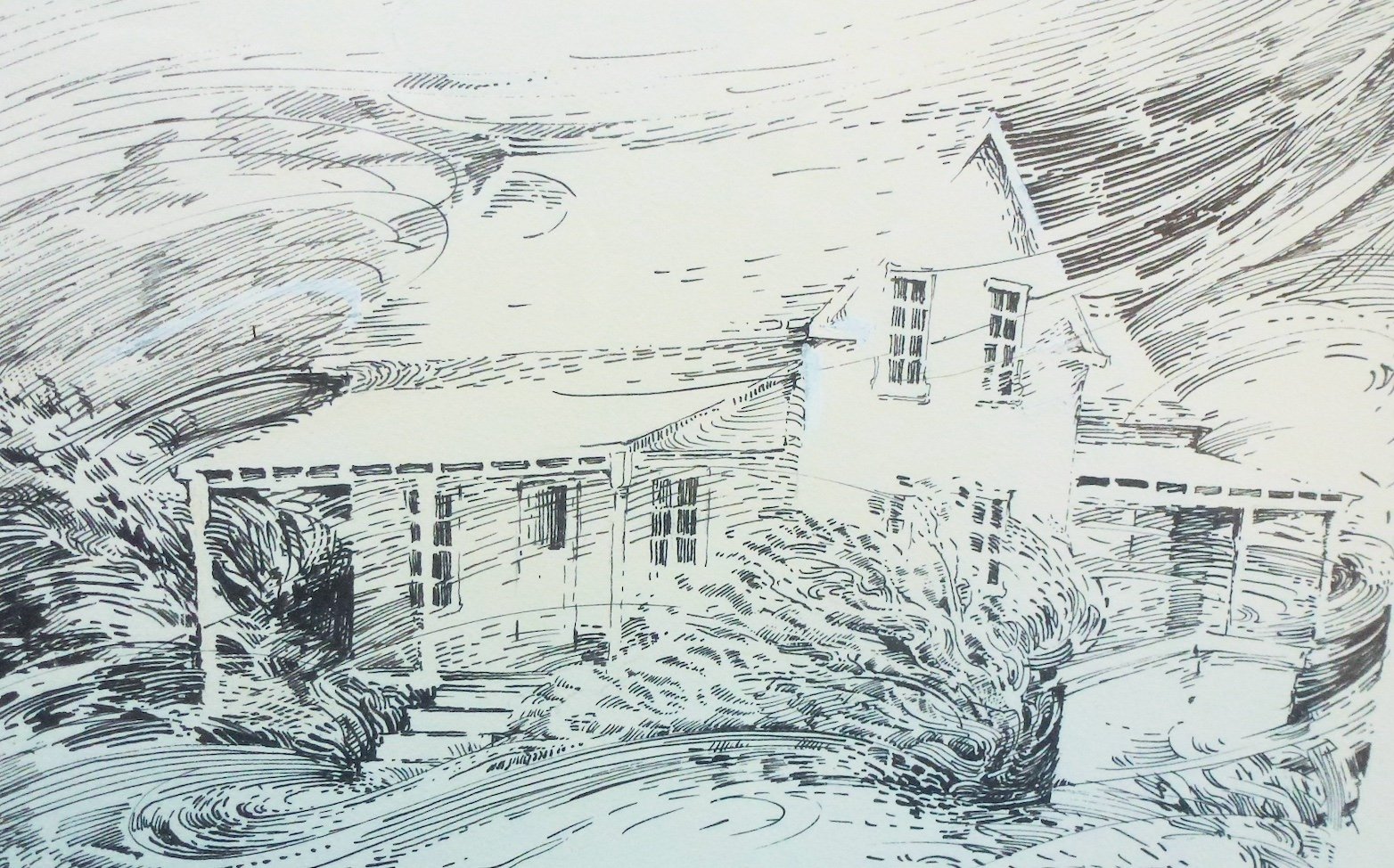
Drawing by Lois Lovejoy, from my book Hatteras Journal
The morning light in our living room was sweet and clear, although the windows through which it poured were thickly coated with salt. Jeff and I sat looking at each other across the room, trying to come to terms.
“This is what we both want,” he insisted. And indeed, it was.
“This” was to stay right where we were, in our little wind-beaten rental house on fragile Hatteras Island. For 18 months we’d been living in the village of Rodanthe, just south of the wide, unspoiled beaches of the Pea Island National Wildlife Refuge. We’d moved to Hatteras so I could write a book, my first. Now the book was finished, but I was having trouble moving on. We’d just learned that this house was being put up for sale. It could be ours.
There is so much to love about Hatteras Island and the rest of the Outer Banks: the long, sandy beaches, the marshes filled with birds. The lovely blue-green surf. The storms, which redraw the islands’ contours and serve as a constant reminder of who’s in charge (not us). I’ve never felt so close to nature as during my time on Hatteras.
But there is also much to fear in a landscape designed to wander and remake itself. If you were to imagine living on the back of a writhing dragon, you wouldn’t be far from the truth. The narrow, barely-above-sea-level ridge that comprises Hatteras Island often shifts unexpectedly. Storms knock down dunes and blow sand into great drifts, burying yards and sometimes even cars. They cut inlets, severing the long thread of the island, daring us to patch it back together. “Dynamic” is a term that comes to life on Hatteras.
It's always been this way—and buyer beware. The part of the island where our little rental house stood had been rated by geologists as extremely unstable. It was just off a historic inlet that had filled in naturally. Who knew when it might reopen? The oceanfront in Rodanthe had an erosion rate of up to 16 feet per year, one of the highest on the coast.
There is no arguing with geology. I knew that, deeply. But I didn’t want to leave a landscape and a culture unlike any other I’d experienced.
Hatteras Island had plenty of vacation homes even then, but they tended to be small. It had abundant character and characters who set it apart from other, better known seaside resorts. I’d met many of these while working on my book.
There was Virginia O’Neal, the longtime village postmistress, famed in those parts for what happened when her husband went fishing one day and didn’t come home. Oscar’s boat was discovered puttering along in Pamlico Sound, its propellor tangled in net. He was nowhere to be found. In time Virginia began to hear him calling her, “Ginny, Ginny, real soft like.” One Sunday as she sat in church his voice became particularly insistent. After the service she asked a cousin to help her search the island shoreline one more time. She found his body not far from where he’d been fishing, where the latest high tide had washed it.
There was Mac Midgett, a gruff, giant man with dark hair and a full beard who cultivated a reputation as the local Blackbeard. One stormy day a freighter ran aground on the Rodanthe oceanfront. Mac tied a line to it and claimed it under ancient maritime law. When the freighter’s insurance adjusters objected, Mac merely stood close, looking down at them. In the end they paid him handsomely for putting together a crew to salvage the cargo.
There was quiet Laura Scarborough, whose grandfather had been captain of the famous Chicamacomico Lifesaving Station. Michael Halminkski, a talented nature photographer who’d come to the island to surf and stayed to spend his life chronicling its beauty and its people. Steve, a local fisherman who shyly brought some bluefish he’d caught by the house for me one day after Jeff had gone to Atlanta to take a job to support us. Turned out the local rumor was that I’d been abandoned by my husband. And there was Robin Gerald, unlike anyone I’d ever meet.
Robin had grown up in Delaware, but to say he’d gone native would be an understatement. “I’d loik to get me some black duck,” he told me one cool day, affecting an island accent. “Black duck, its breast’s the sweetest, sweeter-n others.” He would have known, being such a hunter. He was not one to sit quietly in a blind. Some days he’d turn his canoe upside down and camouflage it with reeds. He’d hide beneath it and crawl slowly through the frigid water out to where the ducks were feeding, carefully holding his rifle out of the water. When he was in easy range of the flock, he’d peer out and shoot.
Hatteras’ long-time residents accept that ocean storms will reshape the land, and that they’d best prepare for it. At times storms send the ocean washing all the way across the island. In the early years smaller, simpler houses were often not attached to their foundations. During ocean surges these might be carried off and set down in new spots. But their interiors remained mostly dry. The families stuffed new foundations beneath them and moved back in. More than anything I’m saddened by the dilution of the local willingness to live with constant change. That, and the quiet neighborliness I found there.
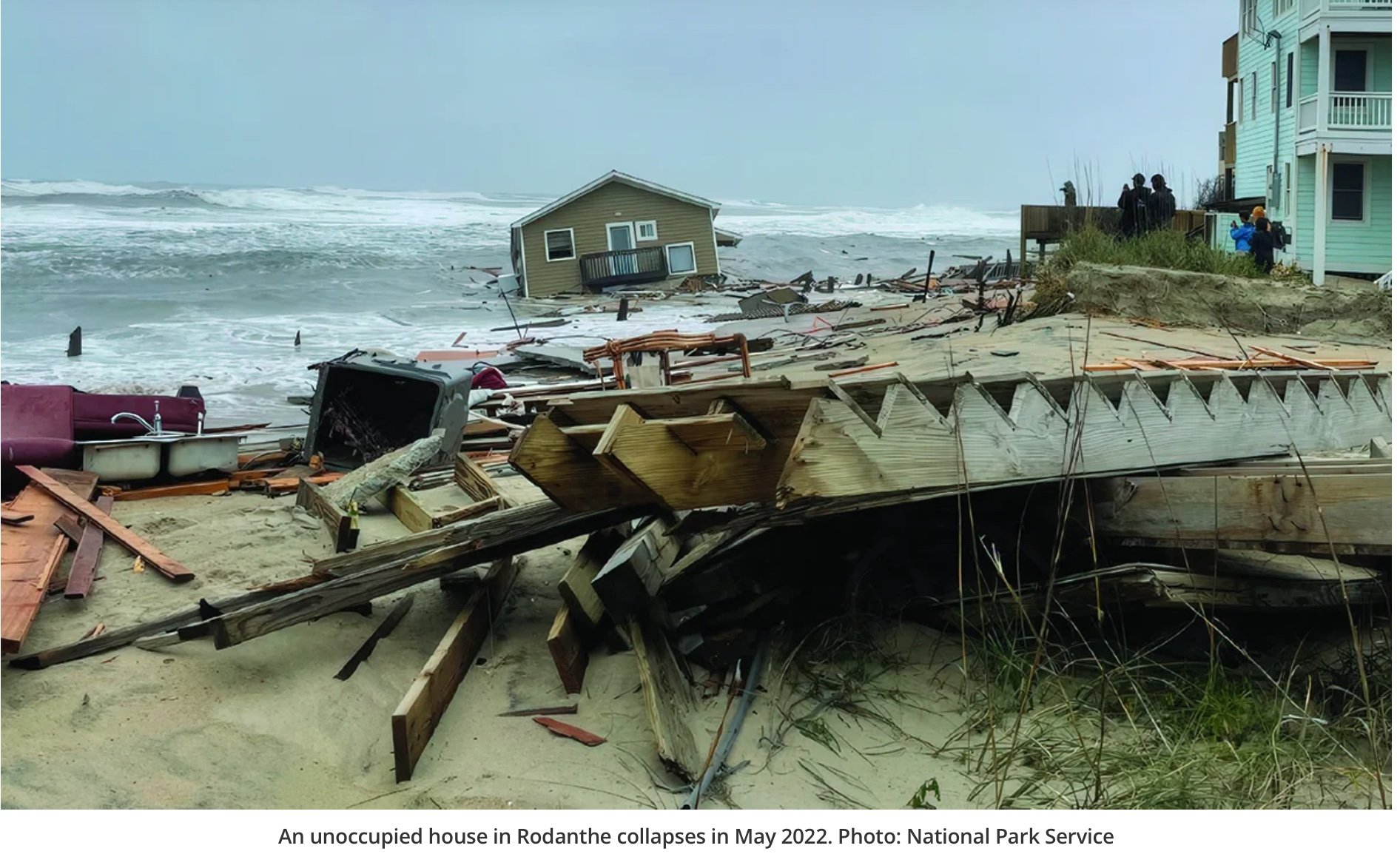
Rodanthe is now best known as a town of collapsing oceanfront houses. I’ve lost count of how many have fallen into the sea. Each one spreads debris through the sand: broken lumber and nails, cracked roof tiles, soggy insulation, chunks of concrete from septic tanks, as well as the sewage they held. Lately the zone of most frequent house collapse has shifted to north Buxton, near where the storied Hatteras Lighthouse was built. That section was also rated by geologists as one of extreme danger. “They moved the Hatteras Lighthouse from right there to a safer place because of high erosion,” an island friend commented recently. “Don’t you think that would have been a hint to the owners of the houses right there?”
And the vacation homes are so much more lavish now! When we moved to Hatteras, the majority of its short-term rentals were simple boxes, even those fronting the sea. No longer. Some of the new, oversized houses even include movie theaters. Their tenants relax in air-conditioned cocoons where they need not interact with local residents, or even the island itself. Sadly, many of those that have fallen are the older structures, holdovers from an era when visitors packed light and spent their days on the beach.
We did not end up buying our little Rodanthe rental house. We moved north to wider, more stable Roanoke Island, and in time to Maine. I often return in my mind to those Hatteras shores, to the days I spent walking the wide, natural beach of the Pea Island refuge, sneaking up on flocks of shorebirds, scrambling up huge dunes to see all the way across the island to Pamlico Sound. Standing on the wide beach in autumn as hawks and falcons flew low, low overhead on their way south, almost, it seemed, within arm’s reach. Erosion has been particularly unkind to Pea Island. The towering dunes and wide, wild beach I so loved there are gone now, grain-by-grain washed out to sea.